What’s Gone Wrong with Aaron Nola for the Phillies

It’s really admirable what the Philadelphia Phillies have done to this point. After a disastrous 9-19 start, the Phillies are currently 38-10 under interim skipper Don Mattingly. You can call it the new manager effect, but this team has played a much better brand of baseball and it’s led to them being in striking distance of the Atlanta Braves in the division. It’s the best record in the sport. They have been great at winning close games, especially the one run games, they have the best road record under Mattingly (24-18), and everything has begun to click. Overall, you have to be very pleased if you are a Phillies fan, but there are concerns to be addressed. One of those concerns is Aaron Nola and what has gone wrong for the Phillies this season.
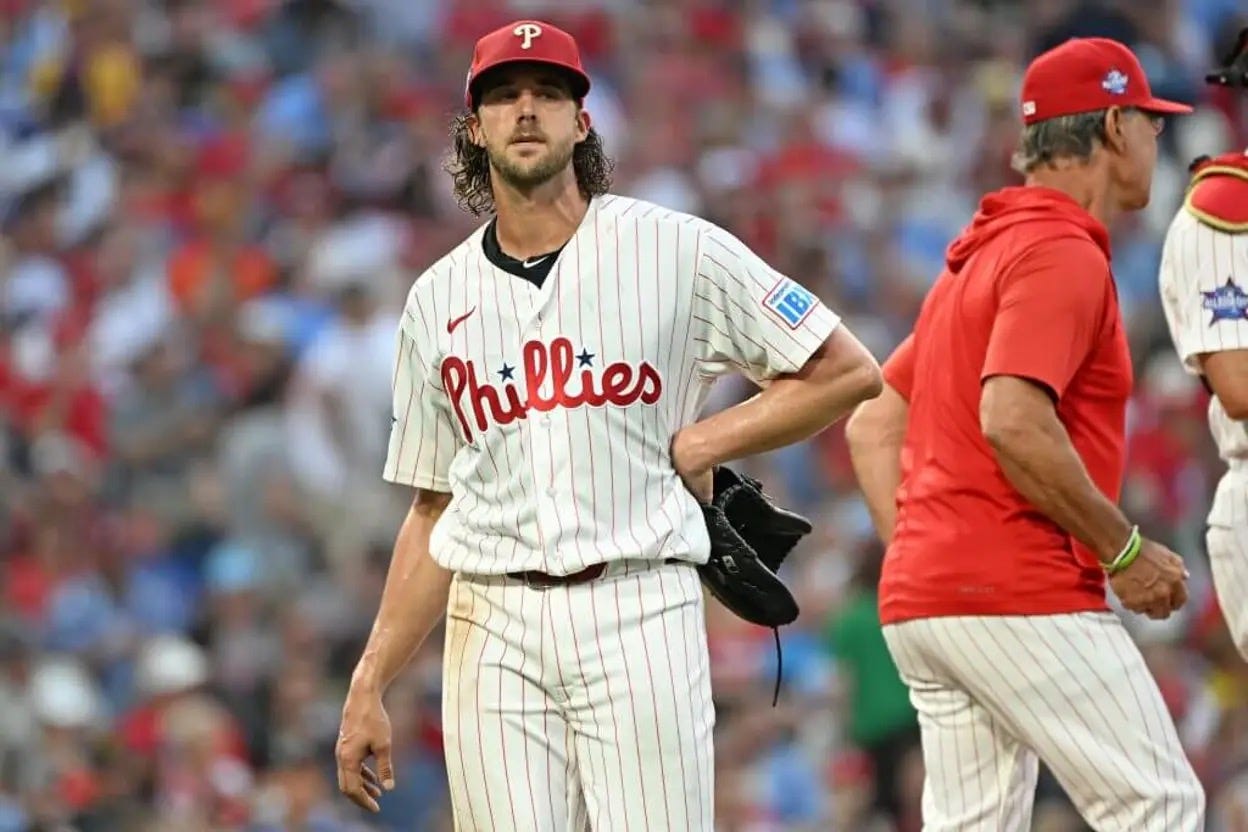
Eric Hartline / Imagn Images
This team has had its struggles with the rotation to start the year. They managed to cut bait with Taijuan Walker, who was ultimately DFA’d after posting a 9.13 ERA across four starts. It was time to see what the rookie and top pitching prospect in the system in Andrew Painter could do and ultimately he struggled. Painter made 12 starts and with less pressure being the fifth starter in the rotation. He posted a 7.13 ERA and a 5.51 FIP. The control wasn’t great, as he averaged 3.32 BB/9 and a BB% of 8. His strikeout rate was the lowest it’s been since he’s entered the Phillies organization (17.7%) and the home runs became a major problem. Ultimately, he got sent down to Triple A, which is best for the player as a whole. Development isn’t linear, but as it pertains to Nola this is a different set of circumstances.
Nola is one of the most decorated pitchers in Phillies history. Nola is seventh in wins, sixth in WAR, second in strikeouts, and third in starts. Those are just some of the rankings for him among those who have gotten to play for the illustrious franchise. He had the chance to test the free agency market, but instead got his deal so he could remain a Philly, signing a seven year, $172 million contract. His first season signing the contract was not bad by any stretch. Nola pitched 199.1 innings, posting a 3.57 ERA to a 3.94 FIP. It proved to be the right investment at the time, but now the Phillies are seeing some regression the last two seasons. The team did acquire and ultimately extend Jesús Luzardo, which is the right move. The stuff and the strikeout ability are massive and he’s a great weapon inside this rotation. But it made Ranger Suarez expendable and he’s now having the best season of his career since 2021.
Nola had a tough 2025. Not just from a results standpoint, but from a health standpoint. For the first time since the shortened season in 2020 due to the Covid-19 pandemic, Nola failed to reach the 100 inning mark. Nola finished the season with a 6.01 ERA (worst of his career), but with a 4.58 FIP. The strikeout rate was right on par with what he was doing the year prior (24%) and so was the walk rate (6.9%), but he had the highest HR/9 of his career (1.72). The stuff was down (102 Stuff+) and you can point to health so the struggles he had. This season is an entirely different conversation because health isn’t the issue.
Nola is seeing similar results to last season, but there’s further explanations for the struggles. After seeing Braxton Ashcraft look human against the Phillies, spotting them a 5-0 lead, Nola had his “hold my beer” moment and gave up seven earned runs (eight total) in 4.2 innings. The Phillies managed to lose the game despite a late game comeback thanks to a lackluster Pirates bullpen. It’s been that story for majority of this season.
12 of his 17 starts he’s given up three or more earned runs. The month of June hasn’t been the kindest, seeing him give up the most earned runs in any calendar month this season (21). For the season, he has a 6.04 ERA, 5.02 FIP, a 1.49 WHIP (career high), and has seen the HR/9 balloon to 2.01 for the year. Not ideal. After having a year by health that derailed his year, it’s now managed to top that.
What is most notable is that his four seam fastball has been getting clobbered this season. Velocity has not been a problem, as his yearly averages are higher on the pitch this season than last season. However, the results are much different. Last season, the four seam fastball had a .230 batting average against and a .529 slug. This season it’s getting hit more and getting hit harder. The pitch now has a 3.88 batting average against and a .791 slug. Furthermore, it had a hard hit rate of 51%, a 6% increase from a season ago. Usage wise, Nola is leaning curveball more, but the four seam fastball and sinker are the pitches playing off it.
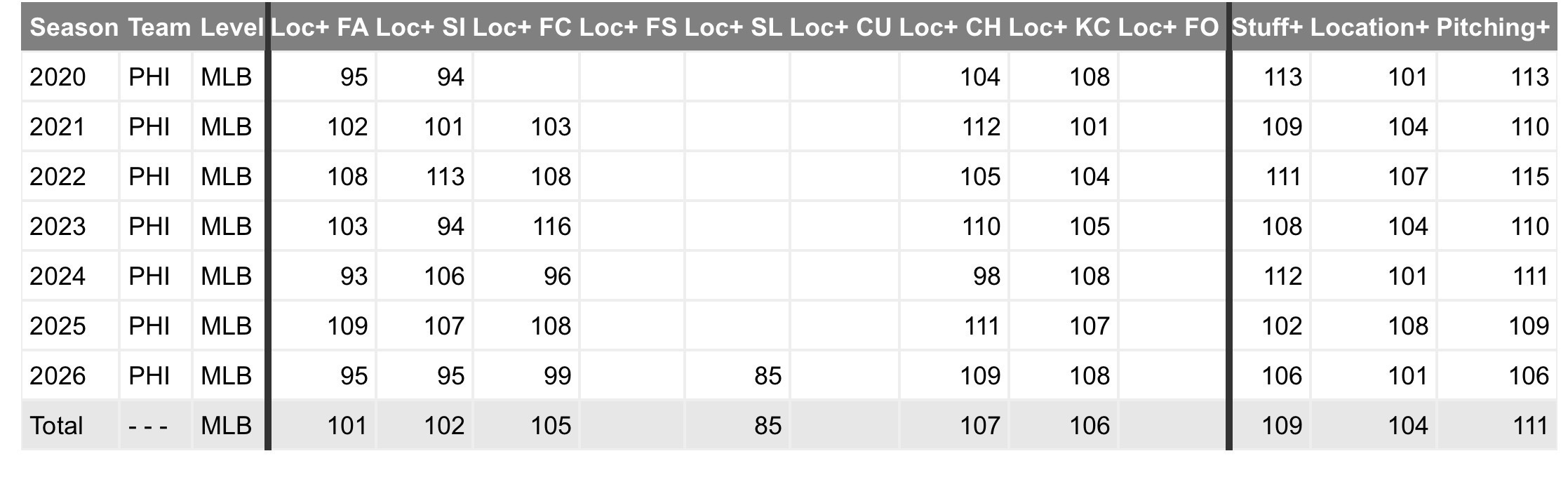
Nola’s four seam fastball is the worst pitch by run value (-13), which is a massive difference from a season ago (-2). While the velocity is present, the command is not. last season across the board, command was very on point, which is exactly what Location+ demonstrates. This season, the command has taken a step back. 100 is average for these types of models and Nola is below average in this regard, especially for his fastballs. The knuckle curve and the changeup are great command pitches. The knuckle curve remains the best pitch by Stuff+ as well (124). Ironically, that pitch has been responsible for five of the last home runs he’s given up. Nola has surrendered eight home runs in his last four starts and has seven multi home run starts this season. It’s truly not a good recipe right now.
The Phillies are facing a harsh reality with Nola, but at this rate you find a way to power through and put yourself and the player in the best spot to succeed. This Phillies team is enduring a great turnaround, as under Mattingly since he took over has the third best starting pitching ERA in the league and overall sits in the top ten. The offense has rounded into form slowly, despite being largely on the backs of Kyle Schwarber, Bryce Harper, and Brandon Marsh. This team is very built for October, especially pitching wise with Cristopher Sánchez, Luzardo, and Zack Wheeler. What type of role Nola will have will be telling, but this year has managed to be more of a struggle than the last and plenty of factors have led to the results.
What a ride it’s been for the Philly faithful this season.
Is there an arm angle difference like Kyle Harrison in Milwaukee? If his velocity is steady in comparison to previous seasons, but his Fastball is flat and hit-able, then what else is there to look at? I’d look at the arm angle. Perhaps that can give the pitch the ride and deceptiveness he needs [not that I actually want to help a Phillies pitcher when I am a Red Sox fan]
Every rotation has that one… (the Nationals have way more than one)